Tampilkan postingan dengan label review. Tampilkan semua postingan
Kamis, 20 Oktober 2016
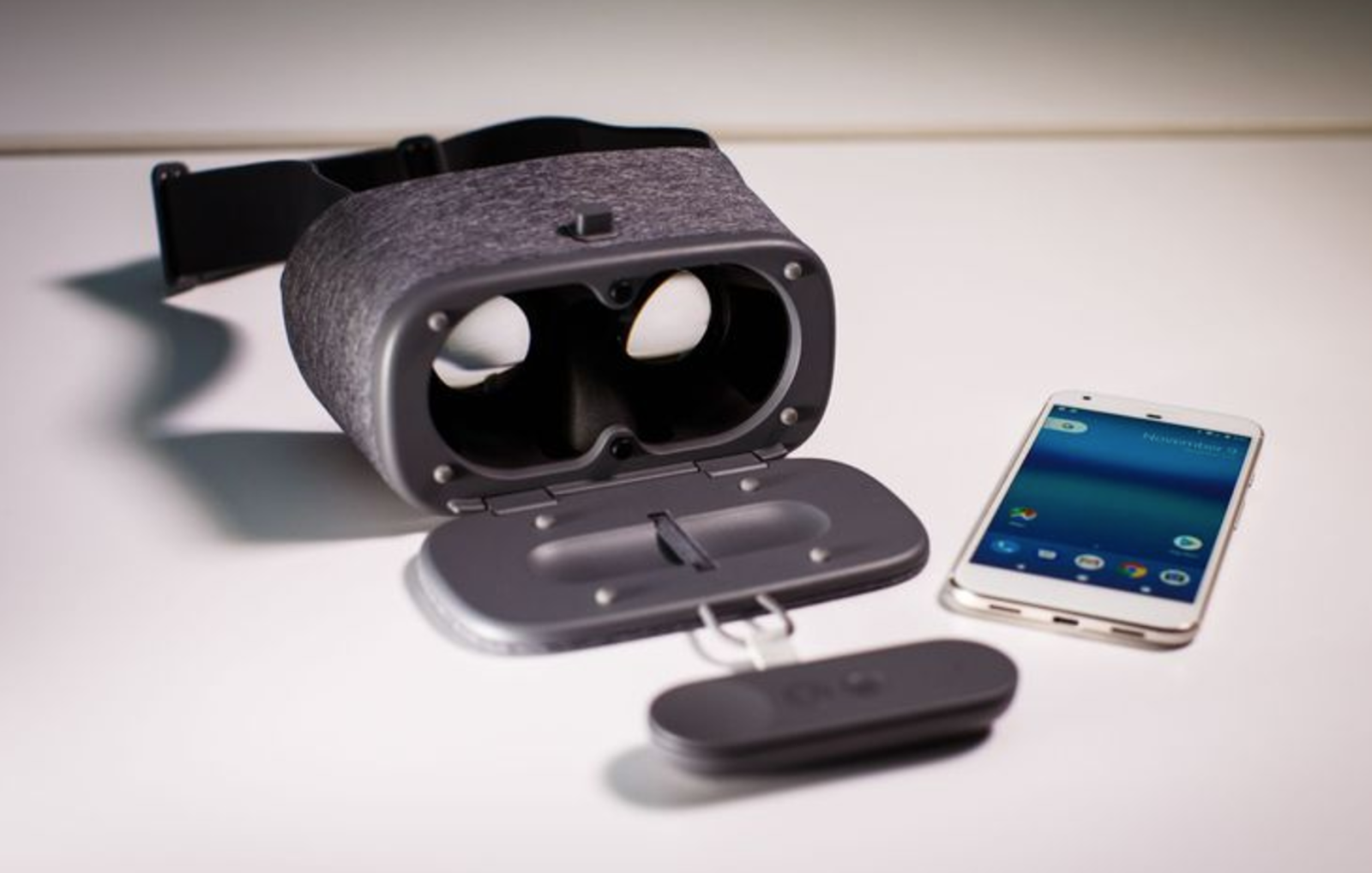
Review : Google Daydream View
Cardboard is cheap. Gear VR only works with Samsung phones. The pricy Oculus Rift and HTC Vive require an expensive gaming PC and loads of setup, and the PlayStation VR needs a PS4.
Virtual reality is hard.
But for $79, £69 or AU$119, Google's new Daydream View could be the break we've been waiting for.
It's a soft cloth eyebox that turns any compatible phone into a VR headset, and it comes complete with its own Wii-like motion controller for manipulating objects and menus in VR.
It's the easiest VR to use by far, But does that mean you should run out and buy one? Not necessarily. Not yet, anyhow.
Magical but murky
One of the pitfalls of most VR is the number of cords, ports and things you have to adjust. The Daydream View puts them all to shame. Here are the steps to set it up:
Open the headset's front door and remove the included controller
Turn on your phone (if it's off) and place it on the door
Close the door, place the headset on your head and adjust until the image looks clear
Adjust the straps
Hold down a button on the controller to calibrate, and start playing.
That's it. No adjusting the lenses, no fiddling with pairing procedures, no ports or cables to plug in. The phone automatically pairs with the headset and adjusts the screen to the correct position, like magic.
Once you're inside, the included motion controller makes navigating menus a breeze. Just point where you want to go, and a little mouse cursor follows your motion quickly and accurately.
Just know that "easy" doesn't mean "perfect."
When I handed the Daydream View to my colleagues, many of them instinctively put it on the wrong way. The curved straps are supposed to rest on top of your head (like a crown) but it's tempting to cinch them down like a pair of ski goggles -- which isn't terribly comfortable.
And though the Daydream View is almost entirely made of soft, cushiony fabric instead of hard plastics, that didn't stop my wife and colleagues from complaining how front-heavy it was with a large Pixel XL phone inside. Even if it weighs less than a pound (roughly 0.85 lbs with the phone) there's still potential for neck strain over time.
The image quality is good -- I definitely felt like I was somewhere else! -- but it's not going to fool anyone who doesn't want to be fooled. And I often found I had to recalibrate the headset and controller in the middle of a session (it's easy -- just hold down the home button).
I even found a bug that makes VR totally unusable until I reboot the phone -- though I understands a software fix for that is coming soon.
Here's the rub: unless you have a Google Pixel or other Daydream-certified phone, the Daydream View won't work at all. That's by design: Google's pitch is that Daydream can keep you from getting sick in VR by ensuring both phones and apps meet a certain quality standard.
But that means a murky future for Daydream, because we honestly don't know how many phone manufacturers and app developers will wholeheartedly support Google's new platform -- or if the results will be as good as these preliminary ones. Even the 5-inch Pixel offers a lesser experience than the 5.5-inch Pixel XL, because its screen is lower-resolution.
Kamis, 13 Oktober 2016
SUSE Linux Enterprise 12 Service Pack 2 arrives
Enhancements to SLES 12 SP2 are across the board. They range from improved networking to greater hardware support to fundamental Linux improvements.
First on the list, SUSE claims a ten-fold increase in packet processing via software-defined networking (SDN). The new SLES combines Open vSwitch with the Data Plane Development Kit (DPDK). DPDK is a set of libraries and drivers for fast packet processing. End result? Faster, more flexible networking. This is a important for telecom providers that are adopting SDN and virtual network functions (NFV).
SUSE is also reducing downtime and improved I/O performance through persistent system memory applications by supporting Non-Volatile Dual In-line Memory Module (NVDIMM). This is a new kind of memory that save data in seconds and make data immediately available on reboot. NVDIMMs combine RAM speed with flash memory persistent storage, and, of course, high prices. But, if you need high-availability, SUSE and NVDIMM is a tempting combination.
Scott Farrand, Hewlett Packard Enterprise's (HPE) VP of Platform Software, said, "Next-generation applications, especially database and analytics applications, require new levels of performance. Through close collaborative engineering, HPE and SUSE have enabled support for NVDIMM technology on SUSE Linux Enterprise Server 12 SP2. This allows customers to begin achieving and exceeding performance requirements for next-generation applications."
SUSE also continues to push forward its market-leading mainframe Linux. This new version features improved IBM Power Systems LC and OpenPOWER servers support. For example, it now supports bare metal
The new SLES also reduced downtime for large-memory IBM POWER-based systems. It does this via minimized memory initialization times for server restarts along with high availability and geo clustering support for IBM POWER.
SLES also now includes support for the ARMv8-A architecture. You can even run SLES 12 SP 2 on a Raspberry Pi 3. More practically, SLES 12 SP 2 is one of this processor's first commercially available enterprise Linux platforms.
One nice universal feature is that SUSE has improved its service pack (SP) implementation. In the past, you had to upgrade from one SP to another step by step. With "skip service packs" functionality customers can jump directly from SLES 12.0 to SLES 12 SP2.
The new SLES also boasts simplified access to the latest packages and technologies via SUSE Package Hub integration with SUSE Customer Center. This enables customers to seamlessly obtain the latest open-source modules and package updates.
Finally, SLES SP2 images are available for public cloud infrastructures, These include Amazon Web Services (AWS), Azure, and Google Compute Engine.
"SUSE Linux Enterprise 12 SP2 has already earned rave reviews from partners and beta testers worldwide," claimed Olaf Kirch, SUSE VP of SLES Enterprise Engineering. "SUSE is committed to enabling customers to bring their state-of-the-art solutions to market faster by leveraging the latest technologies."
So, as you consider which Linux to use for your enterprise, keep SUSE in mind. It has everything businesses need.
Kamis, 15 September 2016
Review : Xiaomi Mi 5
When the Xiaomi Mi3 launched in Malaysia a couple of years ago, it had been, for lack of a better word, a veritable phenomenon; a Full HD smartphone with the blistering, at the time, Qualcomm Snapdragon 800 for under RM1,000 is truly unheard of. As expected, demand became so great that the first flagship smartphone for Xiaomi routinely sold out.
It seemed like everyone and his uncle either had one or is clamouring for one. Xiaomi had seemingly crashed the proverbial party, sending their rivals into a rethink. In the intervening couple of years between then and the launch of their new flagship, the Xiaomi Mi 5, the landscape has changed quite a bit: ‘Flagship killers’ abound, all of which boast high-end specs for a fraction of what they used to cost.
Can the this new entrant maintain Xiaomi’s momentum as it transitions from upstart into a mainstay?
Design: Metallic Compromise
Wrapped in an aluminium shell, the Xiaomi Mi 5 ticks most boxes when it comes to high-end smartphone design. Its curved edges break the monotomy of most boxy designs and makes it looks very similar to Samsung’s Galaxy S7. Where they differ though, is Xiaomi’s decision to make it more of a slant rather than a simple curve, resulting in a chassis that can be rather difficult to hold with confidence.
As I was usually only holding a small surface area of the phone, it always felt like it was going to slip out of my hands. Still, usability aside, it’s certainly a beautiful phone to behold and will attract its fair share of attention.
The volume rocker and power button are easy to depress and provide good tactile feedback. Nested within the physical home button is also a finger print reader like one found on the Apple iPhone. However, Xiaomi’s application leaves a little to be desired; not only does the narrow button consistently fail to identify my fingerprint, it also hangs for some time before it recognises a second input, leading me to simply key in the PIN most of the time.
It also requires the button to be depressed for the fingerprint reader to be activated, a move that is far less efficient than the round back-facing fingerprint reader found on other smartphones like the Google Nexus 6P or ASUS ZenFone 3.
At the very least, it rocks a USB Type-C port. That is a must for flagships now.
Performance: Red Hot Literally
Like most flagships, the Xiaomi Mi 5 packs the latest Qualcomm Snapdragon 820, promising lightning fast speeds and smoothness. Unfortunately, unlike other markets, we’ll only be getting the lower spec variant, clocking in at 1.8GHz compared to the full bore processor at 2.15GHz. Predictably, benchmarks do take a sizable hit, with Geekbench 3 only delivering 1904 for the single core score and 4664 for the multi-core.
This compares poorly against the international benchmarks of around 2300 for the Single-Core and 5300 for the Multi-Core. Thankfully though, general performance of the Xiaomi Mi 5 remains snappy; applications open swiftly, multitasking was a breeze and the Adreno 530 made short work of even the latest games.
Strangely, though, despite the lower clock speed of the Qualcomm Snapdragon 820 processor, the Xiaomi Mi 5 became really hot even doing minor things such as web browsing. Occasionally, the phone would start burning up as it simply sits in my pocket. While the heat didn’t affect the performance of the device much, it is disappointing that the temperature management is a real issue here. Unlike previously, I'd expect most users will now be forced to get a case to deal with it.
Display: Vibrant Enough
Despite only packing a Full HD display compared with the 1440p resolution of something like a LG G5, the 5.15in IPS panel here is absolutely gorgeous, with great brightness, detail and contrast being punched out. At this screen size, pixelation is more or less non-existent and most people will be very happy with it. In terms of colours, it errs towards a more vivid template like a Samsung panel as opposed to more muted, realistic colours you get on the Apple iPhone.
Additionally, while the top and lip of the phone still sport sizable bezels, the sides of the display are almost edge-to-edge, leading to a truly immersive viewing experience when watching videos or playing games.
Audio: Falls Short
Unfortunately, the user immersion is broken down by the sub-par speakers found on the Xiaomi Mi 5. Bad enough that it is down-firing, the single speaker, which is barred up with a single grill piece, barely passes the mustard when it comes to audio fidelity, with overly sharp highs and muddy mids.
The bass is pretty much absent as well, leading to a hollow sounding experience. Thankfully, the Xiaomi Mi 5 still packs a 3.5mm audio jack, so you can quickly plug in a good pair of cans. Unlike an upcoming flagship from Cupertino.
Camera: Commendably Usable
With a 16MP, f /2.0 rear facing camera, the Xiaomi Mi 5 comes loaded with a shooter that is more or less par for the course specs wise. However, when compared to the kings of the hill, it can’t match-up just yet. Make no mistake; this new Xiaomi flagship is definitely a decent shooter.
Most at ease in a brightly lit environment, the Xiaomi Mi 5 main camera is perfectly capable of producing images with decent colours and details. HDR also worked pretty well, though you’ll need some very stable hands to get clear shots.
Where it tends to suffer a little is when the ambient lighting starts getting dark. The software tends to aggressively bump the ISO up, resulting in some pretty grainy images that hurt the overall clarity. While not truly perfect, it’ll definitely do in a pinch.
On the flip side, its front camera will certainly satisfy the selfie taker in most of users as it comes with a wide enough angle lens to get most of subjects in the picture. It also helps that the shots produced are clear and full of detail.
Conclusion: It Delivers as Promised
Xiaomi may still be a juggernaut in the sub-RM1,000 (~US$250) smartphone segment, but as a flagship model approaching the psychological RM2,000 mark, the Xiaomi Mi 5 isn’t such an easy choice.
With competitors like OPPO and OnePlus, the Xiaomu Mi 5 needs to distinguish itself a bit more. It’s certainly a capable smartphone, but there are other options out there that might tempt even the most hardcore of Xiaomi fans around the block.
It seemed like everyone and his uncle either had one or is clamouring for one. Xiaomi had seemingly crashed the proverbial party, sending their rivals into a rethink. In the intervening couple of years between then and the launch of their new flagship, the Xiaomi Mi 5, the landscape has changed quite a bit: ‘Flagship killers’ abound, all of which boast high-end specs for a fraction of what they used to cost.
Can the this new entrant maintain Xiaomi’s momentum as it transitions from upstart into a mainstay?
Design: Metallic Compromise
Wrapped in an aluminium shell, the Xiaomi Mi 5 ticks most boxes when it comes to high-end smartphone design. Its curved edges break the monotomy of most boxy designs and makes it looks very similar to Samsung’s Galaxy S7. Where they differ though, is Xiaomi’s decision to make it more of a slant rather than a simple curve, resulting in a chassis that can be rather difficult to hold with confidence.
As I was usually only holding a small surface area of the phone, it always felt like it was going to slip out of my hands. Still, usability aside, it’s certainly a beautiful phone to behold and will attract its fair share of attention.
The volume rocker and power button are easy to depress and provide good tactile feedback. Nested within the physical home button is also a finger print reader like one found on the Apple iPhone. However, Xiaomi’s application leaves a little to be desired; not only does the narrow button consistently fail to identify my fingerprint, it also hangs for some time before it recognises a second input, leading me to simply key in the PIN most of the time.
It also requires the button to be depressed for the fingerprint reader to be activated, a move that is far less efficient than the round back-facing fingerprint reader found on other smartphones like the Google Nexus 6P or ASUS ZenFone 3.
At the very least, it rocks a USB Type-C port. That is a must for flagships now.
Performance: Red Hot Literally
Like most flagships, the Xiaomi Mi 5 packs the latest Qualcomm Snapdragon 820, promising lightning fast speeds and smoothness. Unfortunately, unlike other markets, we’ll only be getting the lower spec variant, clocking in at 1.8GHz compared to the full bore processor at 2.15GHz. Predictably, benchmarks do take a sizable hit, with Geekbench 3 only delivering 1904 for the single core score and 4664 for the multi-core.
This compares poorly against the international benchmarks of around 2300 for the Single-Core and 5300 for the Multi-Core. Thankfully though, general performance of the Xiaomi Mi 5 remains snappy; applications open swiftly, multitasking was a breeze and the Adreno 530 made short work of even the latest games.
Strangely, though, despite the lower clock speed of the Qualcomm Snapdragon 820 processor, the Xiaomi Mi 5 became really hot even doing minor things such as web browsing. Occasionally, the phone would start burning up as it simply sits in my pocket. While the heat didn’t affect the performance of the device much, it is disappointing that the temperature management is a real issue here. Unlike previously, I'd expect most users will now be forced to get a case to deal with it.
Display: Vibrant Enough
Despite only packing a Full HD display compared with the 1440p resolution of something like a LG G5, the 5.15in IPS panel here is absolutely gorgeous, with great brightness, detail and contrast being punched out. At this screen size, pixelation is more or less non-existent and most people will be very happy with it. In terms of colours, it errs towards a more vivid template like a Samsung panel as opposed to more muted, realistic colours you get on the Apple iPhone.
Additionally, while the top and lip of the phone still sport sizable bezels, the sides of the display are almost edge-to-edge, leading to a truly immersive viewing experience when watching videos or playing games.
Audio: Falls Short
Unfortunately, the user immersion is broken down by the sub-par speakers found on the Xiaomi Mi 5. Bad enough that it is down-firing, the single speaker, which is barred up with a single grill piece, barely passes the mustard when it comes to audio fidelity, with overly sharp highs and muddy mids.
The bass is pretty much absent as well, leading to a hollow sounding experience. Thankfully, the Xiaomi Mi 5 still packs a 3.5mm audio jack, so you can quickly plug in a good pair of cans. Unlike an upcoming flagship from Cupertino.
Camera: Commendably Usable
With a 16MP, f /2.0 rear facing camera, the Xiaomi Mi 5 comes loaded with a shooter that is more or less par for the course specs wise. However, when compared to the kings of the hill, it can’t match-up just yet. Make no mistake; this new Xiaomi flagship is definitely a decent shooter.
Most at ease in a brightly lit environment, the Xiaomi Mi 5 main camera is perfectly capable of producing images with decent colours and details. HDR also worked pretty well, though you’ll need some very stable hands to get clear shots.
Where it tends to suffer a little is when the ambient lighting starts getting dark. The software tends to aggressively bump the ISO up, resulting in some pretty grainy images that hurt the overall clarity. While not truly perfect, it’ll definitely do in a pinch.
On the flip side, its front camera will certainly satisfy the selfie taker in most of users as it comes with a wide enough angle lens to get most of subjects in the picture. It also helps that the shots produced are clear and full of detail.
Conclusion: It Delivers as Promised
Xiaomi may still be a juggernaut in the sub-RM1,000 (~US$250) smartphone segment, but as a flagship model approaching the psychological RM2,000 mark, the Xiaomi Mi 5 isn’t such an easy choice.
With competitors like OPPO and OnePlus, the Xiaomu Mi 5 needs to distinguish itself a bit more. It’s certainly a capable smartphone, but there are other options out there that might tempt even the most hardcore of Xiaomi fans around the block.
Langganan:
Komentar (Atom)


